


40HZ PROJECT / REFLECTION / WORKING HYPOTHESIS
40Hz and the Quantum State of Microtubules
From 39 Hz Electrical Oscillations to Consciousness, Nonlocality and the Microtubule as a Possible Threshold
A 40Hz Project Reflection
September 2026
This article develops a deductive chain. To prevent data and hypotheses from blending together, each step is assigned to one of four levels: experimental observation, published scientific theory, testable 40Hz hypothesis, or speculative Reflection.
| LEVEL | CONTENT |
| OBSERVED | Electrical properties of microtubules; oscillations and conductance changes; neural responses to gamma stimulation. |
| PUBLISHED THEORY | Orch OR: superposition, coherence, entanglement and reduction in microtubules as part of consciousness. |
| 40HZ HYPOTHESIS | A 40 Hz perturbation may propagate from network to neuron and alter microtubular electrical conditions. |
| REFLECTION | The microtubule as a threshold toward nonlocal correlations; firewall, shared informational domain, roulette tables and archetypes. |
1. A convergence worth interrogating
The starting point is not proof but a structured coincidence. Three independently developed lines of inquiry cluster around the same temporal range, approximately 39-40 Hz. The first concerns microtubular electrophysiology. The second belongs to a quantum theory of consciousness. The third is the experimental terrain of the 40Hz Project. None of the three proves the others. Their numerical proximity does, however, allow a precise question to replace a vague suggestion.
- 39 Hz. Brain microtubule bundles and, under different conditions, stabilized single microtubules have shown a prominent electrical component around 39 Hz. [3,5]
- Approximately 40 conscious moments per second. Orch OR describes consciousness as a succession of discrete events at varying frequencies and uses, among its examples, roughly 40 events per second, one every 25 milliseconds. [9,10]
- 40 Hz. The 40Hz Project uses this frequency as a controlled sensory and musical perturbation while observing neural, physiological and subjective effects.
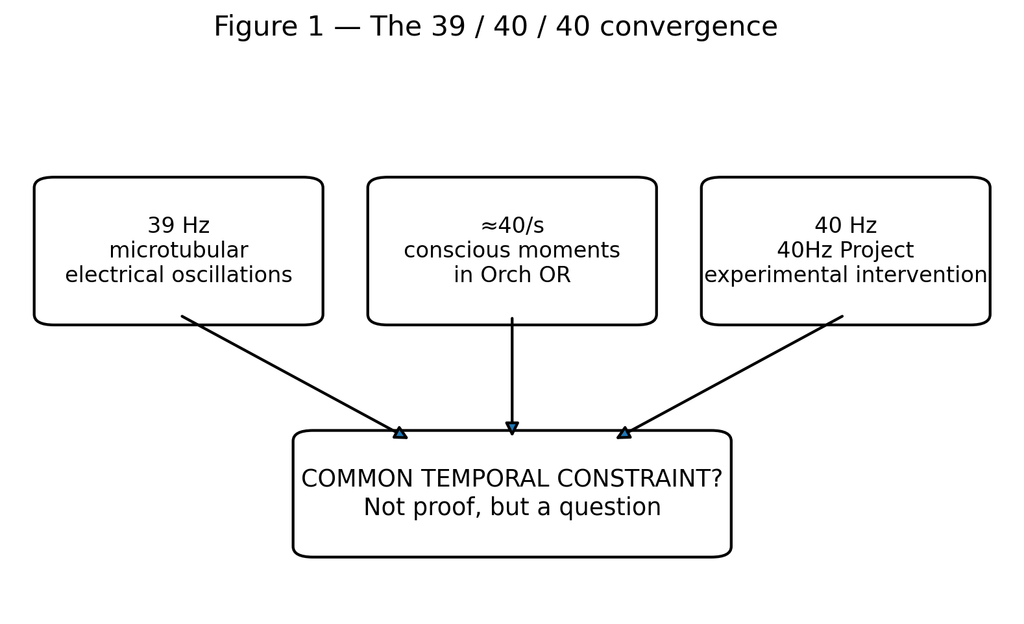
Figure 1. Three distinct phenomena converge numerically around 39-40 Hz; the diagram does not imply identity or causality.
The question is therefore whether 39-40 Hz is merely numerical coincidence or could represent a temporal constraint that reappears across different scales of the nervous system. Two shortcuts must be avoided: declaring a quantum connection too early, or dismissing the numerical convergence before asking whether a physical bridge exists. The more interesting path lies between them: build the bridge one step at a time.
2. Before the microtubule: what 40 Hz can already do to neural networks
The first link in the chain is the strongest. Periodic sensory stimulation can partially synchronize neural activity to the stimulation frequency. In audition, the steady-state response around 40 Hz has been studied for decades as a non-invasive probe of cortical circuit dynamics. Recent reviews confirm that 40 Hz is the most frequently used frequency in gamma entrainment studies, while also showing substantial individual, regional and methodological variability. [7,8]
This matters because it reframes the problem. We do not need to imagine a 40 Hz sound wave physically penetrating down to a single intracellular structure and making it vibrate like a tuning fork. A more ordinary pathway exists: stimulation changes network timing; the network alters the electrical and biochemical state of neurons; that state alters the environment in which microtubules operate.
| FIRST BRIDGE The step external 40 Hz -> neural network is empirically much firmer than external 40 Hz -> microtubule. Our hypothesis therefore begins with network entrainment, not with direct acoustic action on the intracellular structure. |
Nor is 40 Hz magically privileged in every brain. Gamma responses depend on sensory modality, stimulus features, brain region and individual differences. [7] Any real effect will therefore have to be probabilistic and organizational rather than a universal switch.
3. The microtubule beyond the scaffold: an element inside the neural loop
Microtubules are intracellular tubulin polymers that extend through axons and dendrites. They support cell architecture, intracellular transport and the distribution of molecules and organelles, but recent literature also describes them as dynamic elements that respond to neural activity and can influence excitability, plasticity, synapses and memory. [6]
The key concept is bidirectionality. The neuron is not a container holding passive microtubules; network activity changes the neuron, the neuron changes its cytoskeleton, and the cytoskeleton can in turn contribute to changing neuronal behaviour. This feedback allows us to think in terms of a process rather than a one-way chain.
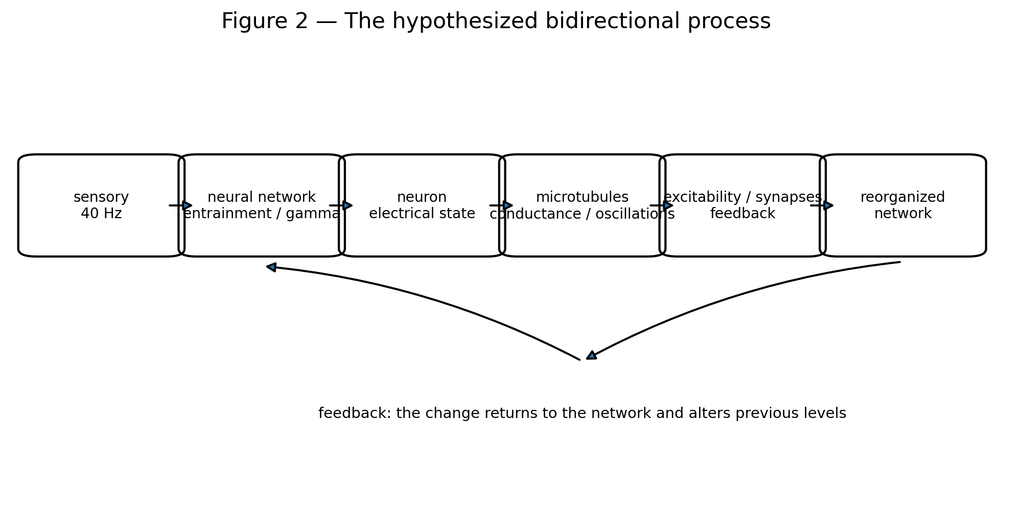
Figure 2. The hypothesized process is bidirectional: the intervention acts on the network, while intracellular changes can return to the network through excitability, synapses and plasticity.
This sequence already defines a complete classical hypothesis: sensory 40 Hz can organize the network; the network changes neuronal state; that new state changes the microtubular regime; microtubules, through their electrical and structural functions, contribute to the next state of the neuron and therefore the network. No quantum superposition is required for this loop to be scientifically interesting.
This is also where the 40Hz Project differs from a narrow entrainment study. We are not interested only in whether EEG shows more 40 Hz power or phase-locking. We are asking whether a temporal perturbation of the network can propagate down in scale, enter the cell, and then return to network dynamics: a multi-scale organization problem.
4. Microtubular electricity: a trajectory rather than a single result
The previous version compressed this section too heavily. There is not one isolated 39 Hz finding. Over the last decade, a small but coherent experimental trajectory has emerged describing microtubules as electrically active structures.
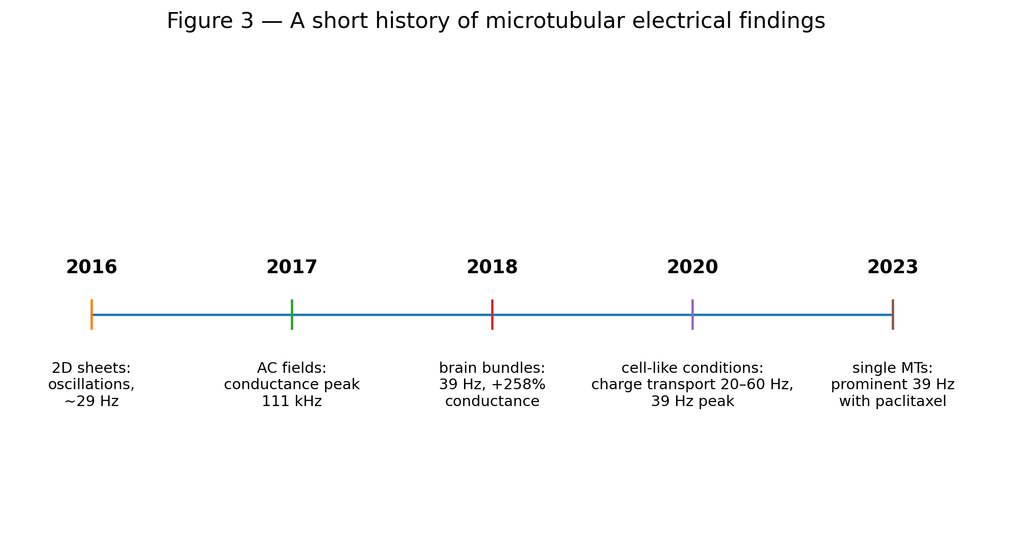
Figure 3. Selected experimental steps that progressively characterized the electrical properties of microtubules.
2016: two-dimensional structures and nonlinear oscillations
Patch-clamped two-dimensional microtubule sheets generated cation-selective oscillatory currents, periodic regimes and more complex behaviours. A prominent fundamental frequency was around 29 Hz and, in physiological potassium, oscillations represented an average 640% change in conductance. Taxol blocked oscillations in that preparation. [1] The exact frequency is not 39-40 Hz, but the prior point is more important: the structure can generate its own nonlinear electrical dynamics.
2017: response to alternating electric fields
A separate group measured conductance in microtubule-containing solutions exposed to alternating electric fields. That system showed a conductance peak around 111 kHz, distinct from the response of free tubulin dimers. [2] The frequency range is far from 40 Hz, but methodologically it establishes that microtubular electrical response depends on the frequency of external excitation and on tubulin polymerization state.
2018: brain microtubule bundles and 39 Hz
In 2018 the picture moved directly toward our question. Brain microtubule bundles under intracellular-like conditions spontaneously generated electrical oscillations and bursts. The most frequently observed fundamental frequency was 39 Hz, and the oscillations represented an average 258% change in ionic conductance. [3]
That 258% should be interpreted precisely. It does not mean 258 times more energy or generic ‘activity’. Expressed as an increase over baseline, it corresponds arithmetically to about 3.58 times the starting conductance. Conductance is the variable: how readily the system allows ionic current to pass. It is an electrical state change, not a measure of biological goodness.
2020: the result that brings the question closer to 40 Hz
A 2020 study examined microtubule ensembles at physiological concentrations under cell-like conditions using frequency-dependent impedance measurements. The authors reported increased capacitance and, crucially, a drop in resistance with charge transport peaking between 20 and 60 Hz. At one studied concentration, the detailed curve showed a peak at 39 Hz. [4]
| WHY THIS MATTERS This is not yet proof that 40 Hz sound enters the brain and entrains microtubules. But it is closer to our question than a purely numerical analogy: an externally varied electrical input already produces a charge-transport response in the 20-60 Hz band, with a 39 Hz maximum under one experimental condition. |
2023: the single microtubule and structural state
In 2023 individual isolated microtubules were examined. At zero holding potential a single microtubule radiated electrical power on the order of 10^-17 W; non-stabilized microtubules showed a richer oscillatory response and two mean conductances, whereas paclitaxel-stabilized microtubules showed a single prominent fundamental peak at 39 Hz. [5] Structural state, conductance and oscillatory spectrum were thus linked within the same object.
The convergence is therefore not simply ‘one paper found 39 Hz’. Microtubular structures oscillate, change conductance, respond in a frequency-dependent way to external fields, and alter their electrical spectrum with polymerization state. The 39 Hz region reappears in multiple experimental configurations. That is a trail to follow, not yet an established mechanism.
5. Structural stability, electrical state and synchronization: three different layers
To avoid turning convergence into false causality, three properties must remain separate even when they interact.
- Structural stability: persistence of the microtubule architecture relative to polymerization and depolymerization.
- Electrical state: conductance, impedance, capacitance, currents and oscillatory regime.
- Synchronization or entrainment: the temporal relationship between a microtubular oscillation and an external or neuronal rhythm.
Paclitaxel and epothilones act directly on structural stability. Electrical studies show that structural modification can be accompanied by different electrical organization. The reverse direction, which would be especially relevant for 40Hz, is not established: we do not know whether a 40 Hz perturbation physically stabilizes a microtubule, and that cannot be inferred from the fact that a stabilized microtubule shows a 39 Hz peak.
Anesthesia studies require the same discipline. In 2024 a single epothilone B administration delayed loss of righting reflex under isoflurane in rats; in 2026 a similar mouse experiment found a smaller but significant delay. [14,16] Other prolonged microtubule-drug protocols have produced different and even opposite shifts depending on the compound. [15] These results support a contribution of microtubular state to anesthetic sensitivity, but they do not isolate a quantum mechanism and do not equate ‘stability’ with ‘consciousness’.
The same caution applies to wellbeing. There is no intrinsically ‘positive electricity’ in a microtubule. A beneficial state, if one exists, would be a functional configuration: some relationship among conductance, oscillatory regularity, synchronization with the network, excitability and physiological context. The value lies in organization, not maximal current.
6. The bidirectional process: from 40 Hz to the microtubule and back
The complete classical pathway can now be stated as a six-step process. Its strength is that every step is, at least in principle, measurable without assuming Orch OR.
- Sensory perturbation. The system receives a stimulus with periodicity around 40 Hz.
- Network entrainment. Part of neural activity becomes temporally aligned to the stimulus, changing gamma power and phase-locking.
- Change in neuronal state. Firing patterns, excitation-inhibition balance, ion flux, intracellular calcium, neuromodulation and synaptic activity change.
- Change in the microtubular environment. The cytoskeleton receives a new set of electrical, chemical and mechanical conditions; its conductance and oscillatory regime may change.
- Intracellular feedback. Microtubules and associated proteins influence transport, receptors, channels, plasticity and synaptic organization.
- Network reorganization. The modified neuron participates in a new collective dynamic, closing the loop.
Step 4 is currently the least measured in the context of sensory 40 Hz stimulation and therefore one of the most valuable targets for experiment. The goal is not to prove the entire circuit in a single study, but to determine whether each link has a measurable and temporally compatible signature.
Bidirectionality also means that a small intracellular change need not remain small. In a recurrent system, altered thresholds or conductance across many structures can feed back into the network and change how the network responds to the next stimulus. 40 Hz may therefore become not only an input but a condition progressively incorporated through feedback.
7. The missing experiment: from electric field to the living brain
Existing studies now allow the gap to be defined more precisely. It is no longer true that microtubules have never been probed across external frequencies: the 2017 work explored high-frequency AC response, while the 2020 study examined low frequencies and found charge transport in the 20-60 Hz range with a 39 Hz peak under one condition. [2,4]
What remains missing is the bridge between those in-vitro preparations and a sensory perturbation acting through a living neural network. At least two parallel programs are needed. The cellular program should directly stimulate microtubular preparations using controlled low-frequency sweeps, for example 30, 35, 39, 40, 45 and 50 Hz, measuring conductance, phase, amplitude, state transitions and dependence on structural stabilization. The neurophysiological program should ask whether network entrainment at 40 Hz produces intracellular changes compatible with the in-vitro signatures.
| A CRITICAL DISTINCTION An impedance or charge-transport peak at 39 Hz in vitro is not the same as microtubular entrainment in vivo. But it turns the hypothesis from pure numerical analogy into a physical frequency-response question that can be tested. |
8. Where quantum physics enters: what Orch OR actually proposes
Only here does the quantum branch become useful. Orch OR, developed by Roger Penrose and Stuart Hameroff, proposes that configurations within microtubules may sustain quantum coherence, superpositions and entanglement for a period, and that a subsequent objective reduction contributes to a conscious moment. [9,10]
Three concepts should be separated. Superposition means that the system state is represented as a combination of possibilities. Coherence means that phase relations among those possibilities remain defined. Entanglement describes quantum correlations between parts of a system that cannot be reduced to independent local states. None of these processes, as a functional mechanism of consciousness in neuronal microtubules in vivo, is currently an established experimental fact.
Decoherence and reduction are also distinct. Decoherence is the loss of quantum coherence through interaction with the environment; Penrose’s objective reduction is a specific physical mechanism proposed by the theory. A long-standing objection to Orch OR concerns whether sufficiently coherent states can survive in the warm, wet, noisy brain. [12,13]
Recent literature includes both arguments reopening the plausibility of functional quantum effects in biological structures and substantial criticisms. [17] In this article, therefore, the ‘quantum microtubule’ is not a result; it is the theoretical branch that becomes interesting only if the classical branch first yields a credible physical bridge.
9. About 40 conscious moments per second: the frame problem
Orch OR does not necessarily treat consciousness as an indivisible continuous stream. Hameroff and Penrose discuss discrete conscious events at varying frequencies and explicitly use, as one example, approximately 40 conscious moments per second synchronized across neurons. In related formulations, 25 milliseconds is used as the timescale for an Orch OR event associated with 40 Hz gamma synchrony. [9-11]
This is the conceptual origin of The Space Between Frames. The cinema metaphor is not meant literally. It asks a sharper question: if experience emerges through a sequence of selected states, what happens while the system is still evolving through a space of possibilities and the next state has not yet been selected?
This is where 39/40/40 becomes more than an aesthetic coincidence. A roughly 25 ms scale appears in a consciousness theory; 39 Hz appears in microtubular electrical measurements; 40 Hz can organize neural networks. If coupling exists across those scales, the frequency could mark a zone of temporal compatibility between network and intracellular structure. That remains a possibility, not a conclusion.
10. From the coin to the roulette table: not consciousness ON/OFF, but specific content
Superposition is often introduced with a coin: heads or tails. That is useful for introducing multiple possibilities but misleading for consciousness. If a reduction event contributed to a conscious moment, the outcome would not simply be ‘consciousness on’ versus ‘off’. It would be a specific configuration embedded in a brain with memory, history, body and context.
The roulette table is therefore a better metaphor, not because microtubules are literally random like a casino, but because it separates three elements:
- The table: the space of possible configurations.
- The probability distribution: the relative weight of configurations under current conditions.
- The outcome: the configuration that is actually selected and, within the model, contributes to a specific conscious moment.
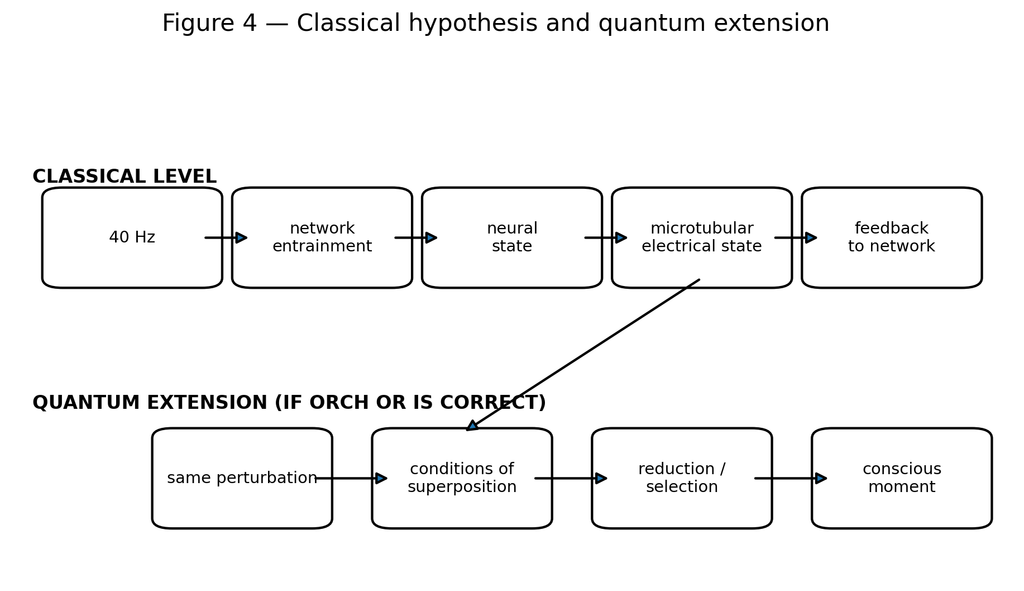
Figure 6. The roulette metaphor separates the structure of the possibility space, the conditions that weight possibilities, and the individual conscious outcome.
In this scheme, 40 Hz need not choose the winning number. It may alter the table or the probability distribution. This allows the same stimulus to produce convergence of state without erasing individuality. Ten people might show greater calm or similar time distortion while continuing to think about ten different things.
Indeed, identical content across people would be biologically more surprising. A personal system should continue to use its own memories and history. What might converge is the form of experience rather than its specific object.
11. The microtubule as a threshold: between local physicality and possible nonlocality
This is the central deductive step. A neuron contains many elements described by chemistry, electrophysiology and molecular biology. All matter is quantum at a fundamental level, so it would be incorrect to call the microtubule the only ‘quantum object’ in the cell. The more specific point is that the microtubule is one of the few intracellular candidates for which an explicit model has been developed linking quantum dynamics, neural organization and consciousness.
If the superposition and entanglement proposed by Orch OR were real and functionally relevant, the microtubule would acquire a distinctive property within our model: it would simultaneously be a local biological structure embedded in neuronal causality and a structure capable, at least in principle, of participating in nonlocal quantum correlations. This is the sense in which we call it a threshold.
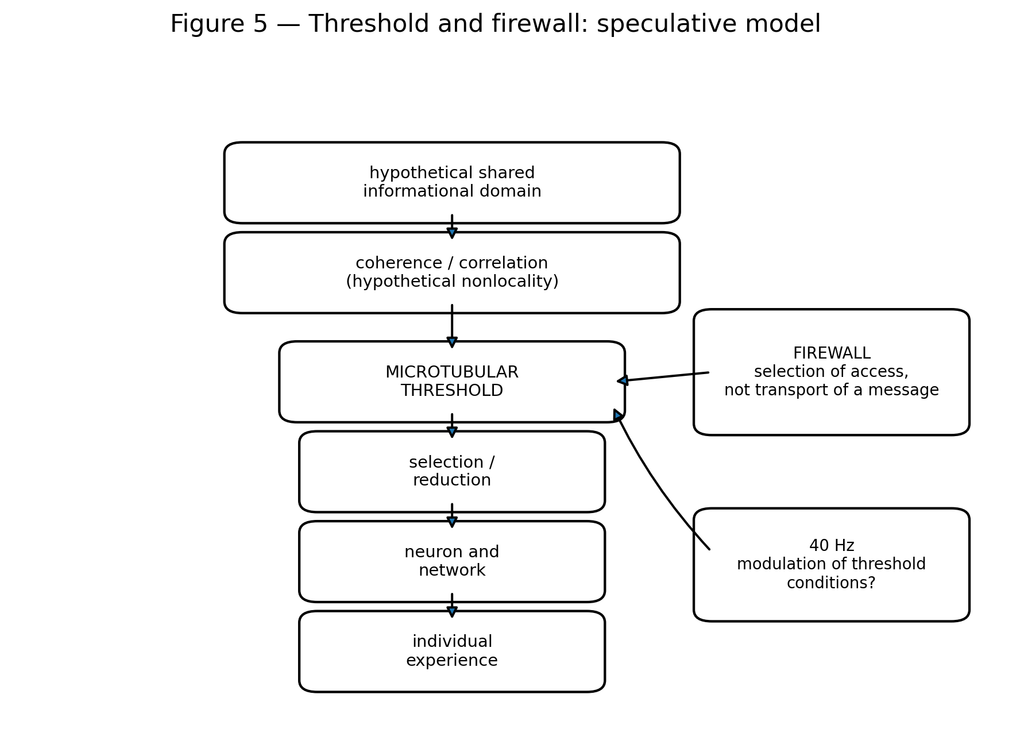
Figure 4. The same perturbation can be described entirely at a classical level; the quantum extension is added only if Orch OR is correct.
Threshold does not mean a demonstrated doorway and does not imply that macroscopic information freely crosses the brain. It names the theoretical place where two descriptions might meet: a quantum configuration is selected and the result enters ordinary electrical and molecular neuronal dynamics. In the reverse direction, network and neuronal state would contribute to orchestrating the initial conditions of microtubular dynamics. The threshold is therefore intrinsically bidirectional.
12. Nonlocality: the problem may be access, not arrival
Once nonlocality is introduced, an obvious question appears: if a shared informational dimension existed, how would information reach the microtubule? The wording already assumes a classical picture in which content leaves one place, travels through space and arrives somewhere else.
Entanglement does not operate like a radio channel and, by itself, does not permit controllable faster-than-light information transfer. If the Reflection is to remain internally coherent, the question must change. Information need not ‘arrive’. It could, hypothetically, already belong to a structure of correlations to which the local system has access only under particular conditions.
This reconnects directly with the earlier 40Hz Reflection that described consciousness as an interface between global coherence and local fragmentation. There, consciousness was not treated as a central archive but as an interface serializing access into local frames, a kind of temporal firewall. Locality protects the stability of the individual; global coherence represents a wider relational structure; experience emerges from the negotiation between the two regimes.
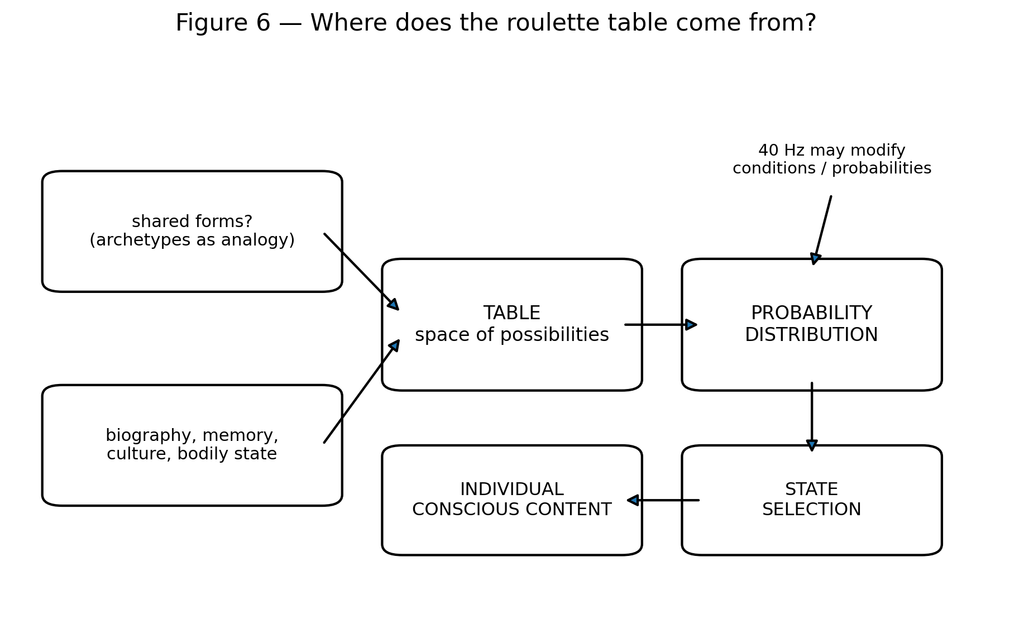
Figure 5. The firewall model does not describe a message entering from outside, but hypothetical selection of access to a pre-existing structure of correlations.
The microtubule now supplies the piece that was physically missing from that earlier Reflection. If Orch OR were correct, the threshold between coherence and localization would no longer be only a metaphor of consciousness; it would have an intracellular candidate. The speculative sequence becomes:
| SPECULATIVE PROCESS shared informational domain <-> correlation/coherence <-> microtubular threshold -> state selection -> neuron -> network -> individual conscious moment |
This must be stated strongly: a ‘shared informational domain’ is not a demonstrated consequence of entanglement. It is our ontological extension. Once declared as such, however, it removes the false problem of a signal travelling through space and shifts attention toward what would actually need to be measured: conditions of access and selection.
The same applies to presentiment, discussed in the previous Reflection. Within this model it should not mean receiving a fixed future. At most, it could mean access to a topology of possibilities or bifurcations: constraints and structures rather than predetermined outcomes. Local choice and individual history remain part of the process.
13. The firewall as serialization: why consciousness might need filtering
If a biological system had unrestricted access to a vastly larger domain of correlations, the result would not necessarily be richer consciousness. It might be noise. An organism must preserve identity, continuity, goals, memory and the ability to act. From this perspective the firewall is not an obstacle but a survival function: it reduces complexity into a locally manageable sequence.
The earlier Reflection described an abstract cycle: global coherence -> local fragmentation -> choice -> decoherent collection -> structural reintegration. Introducing the microtubule gives that cycle a possible material level. Network conditions orchestrate intracellular state; selection produces a local configuration; that configuration influences behaviour and network; the result returns as a new initial condition.
The ‘space between frames’ would therefore not be empty but a phase of possibility. The frame is what becomes locally stable enough to be experienced, remembered and used for action. The temporal firewall prevents the system from having to contain all possibilities at once and produces apparent continuity through successive selections.
14. Where does the table come from? Jung and archetypes as a structural analogy
If the roulette represents a possibility space, the next question is who builds the table. The simplest answer is entirely internal. Genetics, development, memory, culture, body, emotion and current state define the available configurations. This model is sufficient and should always be considered first.
The more radical Reflection adds a second contribution: if a shared domain of correlations existed, part of the table’s structure might not be produced solely by the individual. Carl Gustav Jung’s archetypes become an interesting analogy here. Jung did not describe archetypes as identical memories possessed by everyone, but as recurring forms that organize different contents. [18]
- Archetype as form: not a specific image but a recurring structure such as separation, union, protection, threat, transformation, journey, death and rebirth.
- Biography as content: faces, places, memories, language and culture with which the individual fills that structure.
- Conscious moment as outcome: the concrete configuration emerging from form, personal history and present state.
Two people could therefore produce completely different contents organized by a similar phenomenological structure. One remembers a mother, another sees a house, a third feels protection or loss. Convergence would lie in form rather than identical symbols. This is a much more interesting experimental target than telepathy-like transmission of matching images.
Nothing in this analogy demonstrates that archetypes are quantum. Its value is methodological: it turns a philosophical idea into a potentially observable variable, the structure of experience, distinct from individual narrative content.
15. What 40 Hz might actually do in this model
The levels can now be reunited. In the most conservative model, 40 Hz is a perturbation that changes network timing and, through the network, intracellular bioelectrical conditions. In the extended model, if Orch OR is correct, the same conditions might also alter the landscape of possibilities prior to selection. In the most speculative model, if a shared informational domain exists, the microtubular threshold might modulate access to forms or correlations already present.
The most compact formulation is therefore: 40 Hz does not carry information into the brain; it may alter the conditions through which the brain selects the information or structures to which it has access.
This also clarifies why wellbeing and conscious content are separate questions. Greater electrical and network regularity could produce calm, reduced stress or clearer attention without any nonlocal access. Conversely, structural convergence in subjective content would require a different explanation and a different set of measurements.
The appearance of 39-40 Hz both in network dynamics and in some microtubular measurements suggests, still hypothetically, the possibility of cross-scale coupling. If two systems possess compatible temporal windows, causal exchange between them may become more efficient without either system transmitting its content to the other. This is one reason frequency may matter as a coordinating condition rather than as a message.
16. A multi-level experimental programme
To prevent the article from remaining a speculative exercise, the hypothesis must be translated into a programme able to distinguish outcomes. The aim is not one omnipotent experiment but convergence among independent measurements.
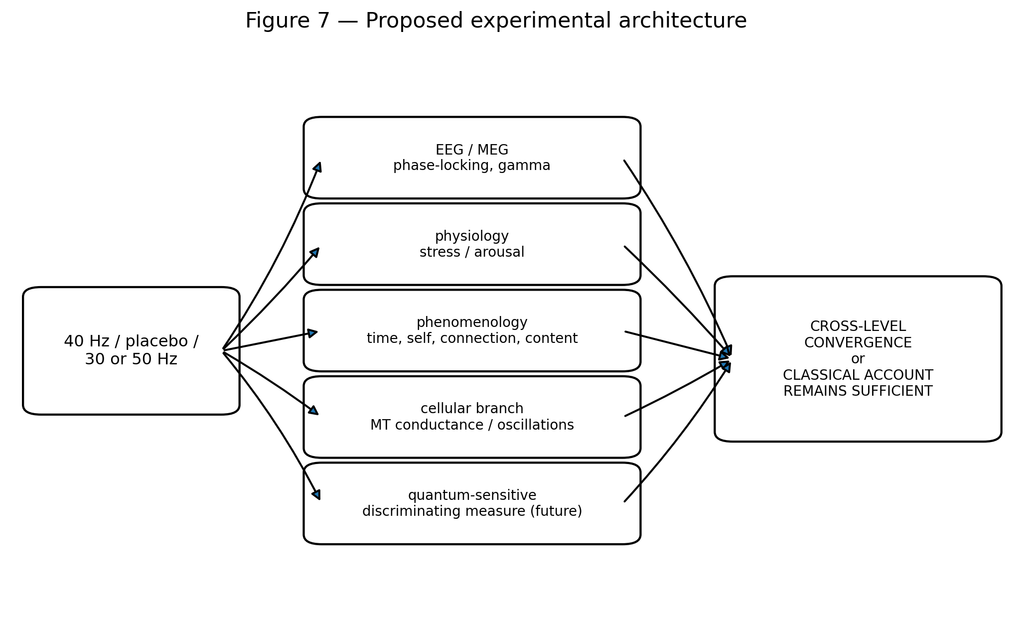
Figure 7. A multi-level architecture: the same intervention is observed at network, physiological and experiential levels, with a separate cellular branch and a future quantum-sensitive branch.
Level 1. Physical perturbation
Compare 40 Hz, placebo and at least one nearby active frequency such as 30 or 50 Hz, with randomized order and standardized intensity and duration. In musical paradigms, the artistic layer should be held as constant as possible so that the relevant difference is temporal modulation rather than composition.
Level 2. Neural network
Use EEG or MEG to measure phase-locking, gamma power, functional connectivity and onset/offset dynamics. The question is not simply ‘is there more 40 Hz?’ but how the network reorganizes, where, and for how long. Individual differences should be treated as data rather than noise. [7,8]
Level 3. Physiology and regulation
Perceived stress, arousal, heart rate, heart-rate variability, respiration and, when available, EMG. This level asks whether network reorganization is accompanied by a change in autonomic and bodily state.
Level 4. Phenomenology
Separate wellbeing from structure of consciousness. For wellbeing: calm, tension, state anxiety, bodily comfort, emotional valence, clarity and fatigue. For structure: time perception, continuity of self, self-environment boundary, connection, presence, imagery, thoughts, spontaneous associations and subjective transitions.
To test the table/archetype component, content should be coded blind for abstract structures rather than literal symbols. Coders should ask whether patterns such as separation/union, threat/protection, expansion/contraction or passage/transformation recur without knowing the participant’s stimulation condition.
Level 5. Cellular branch
In a separate microtubule or neuronal preparation, perform low-frequency sweeps around the critical region and measure conductance, impedance, phase, amplitude, oscillatory regularity and state transitions. The key question is whether 39-40 Hz emerges as a robust property and whether the response depends on structural stability.
Level 6. The genuine quantum test
No combination of EEG, questionnaires and microtubular conductance would by itself demonstrate Orch OR. A specifically quantum claim requires a measurement sensitive to a property not adequately explained by classical dynamics: functional quantum coherence, entanglement or a reduction signature with distinctive predictions. Until such a measure exists, the quantum layer remains a theoretical extension.
17. How to interpret possible results
The advantage of this architecture is that it avoids all-or-nothing reasoning. Different outcomes would support different levels of the model.
| RESULT | CAUTIOUS INTERPRETATION |
| Wellbeing changes, no specific network signature | Possible nonspecific, contextual or musical effect; does not support a frequency-specific mechanism. |
| Network synchronizes and wellbeing changes | Supports a classical entrainment and regulation account. |
| Network changes and the cellular branch shows a selective 39-40 Hz response | Strengthens a classical multiscale bridge between network and microtubule. |
| Recurring phenomenological structures appear across participants | Interesting phenomenon, but still compatible with classical cognitive and cultural mechanisms. |
| A specific quantum signature covaries with network and phenomenology | Would be the first kind of result capable of seriously supporting the Orch OR extension. |
| 40 Hz does not differ from placebo or nearby frequencies | Would weaken frequency specificity and force revision of the model. |
This hierarchy matters. Psychological convergence does not prove collective consciousness. A microtubular response does not prove superposition. An anesthesia association does not prove Orch OR. But each level can narrow the explanatory space and make the next question more precise.
18. Reflection: from coincidence to a research programme
The path begins with three nearly identical numbers and ends with a much larger question. 39 Hz appears in multiple electrophysiological microtubule experiments. Approximately 40 conscious events per second appear in a theoretical model of consciousness. 40 Hz is the frequency with which our project perturbs a neural network through sound. Their proximity is not proof, but it is now articulated enough to be more than curiosity.
The decisive move is bidirectionality. If 40 Hz changes the network, the network changes the microtubule, and the microtubule can in turn change excitability, synapses and network dynamics, then at least in principle there is a circuit through which an external frequency can become an internal condition and return to organize the system. That is already a strong biological question.
Orch OR adds a second layer. If superposition, coherence and entanglement in microtubules were relevant to consciousness, the intracellular structure would become a natural candidate threshold between the local neuron and nonlocal quantum dynamics. Not the only quantum object in the brain, but a particularly interesting candidate because it is already embedded in neural circuitry and already has measurable electrical properties.
Our Reflection adds the most speculative layer. If nonlocality had a broader informational counterpart, information need not arrive from an ‘outside’; it could already belong to the correlation structure in which the system is embedded. The firewall would then describe selection, the microtubular threshold a possible physical point of access, the roulette table the space of possibilities, and archetypes a metaphor for shared forms filled with individual content.
| THE STRONGEST FORMULATION WE CAN CURRENTLY DEFEND 40 Hz may not transmit content into the brain. It may modify the temporal and electrical conditions through which the brain organizes, selects and makes one possibility conscious. Everything beyond this formulation must be earned experimentally. |
The value of the hypothesis therefore lies not in providing an immediate answer, but in turning distant intuitions into a sequence of tests. From 40 Hz to network. From network to neuron. From neuron to microtubule. From microtubule back to network. And only if the data require it, from classical dynamics to a quantum threshold and the question of nonlocal consciousness.
References
1. Cantero MR, Perez PL, Smoler M, Villa Etchegoyen C, Cantiello HF. Electrical Oscillations in Two-Dimensional Microtubular Structures. Scientific Reports. 2016;6:27143. doi:10.1038/srep27143.
2. Santelices IB et al. Response to Alternating Electric Fields of Tubulin Dimers and Microtubule Ensembles in Electrolytic Solutions. Scientific Reports. 2017;7:9594. doi:10.1038/s41598-017-09323-w.
3. Cantero MR, Villa Etchegoyen C, Perez PL, Scarinci N, Cantiello HF. Bundles of Brain Microtubules Generate Electrical Oscillations. Scientific Reports. 2018;8:11899. doi:10.1038/s41598-018-30453-2.
4. Kalra AP et al. Investigation of the Electrical Properties of Microtubule Ensembles under Cell-Like Conditions. Nanomaterials. 2020;10(2):265. doi:10.3390/nano10020265.
5. Gutierrez BC, Cantiello HF, Cantero MR. The electrical properties of isolated microtubules. Scientific Reports. 2023;13:10165. doi:10.1038/s41598-023-36801-1.
6. Peña-Ortega F, Robles-Gómez AA, Xolalpa-Cueva L. Microtubules as Regulators of Neural Network Shape and Function: Focus on Excitability, Plasticity and Memory. Cells. 2022;11(6):923. doi:10.3390/cells11060923.
7. Longo AR, Bolognini N, Zapparoli L. Shaping gamma oscillations through sensory stimulation: A systematic review in healthy adults. Biological Psychology. 2026;204:109211. doi:10.1016/j.biopsycho.2026.109211.
8. Mockevičius A et al. Developmental and aging trajectories of 40-Hz auditory steady-state responses: A systematic review across the human lifespan. Developmental Cognitive Neuroscience. 2026;79:101690. doi:10.1016/j.dcn.2026.101690.
9. Hameroff S, Penrose R. Consciousness in the universe: A review of the ‘Orch OR’ theory. Physics of Life Reviews. 2014;11(1):39-78. doi:10.1016/j.plrev.2013.08.002.
10. Hameroff S. How quantum brain biology can rescue conscious free will. Frontiers in Integrative Neuroscience. 2012;6:93. doi:10.3389/fnint.2012.00093.
11. Hameroff S et al. A quantum approach to visual consciousness. Trends in Cognitive Sciences. 2001;5(11):472-478. doi:10.1016/S1364-6613(00)01774-5.
12. McKemmish LK et al. Penrose-Hameroff orchestrated objective-reduction proposal for human consciousness is not biologically feasible. Physical Review E. 2009. PMID:19792156.
13. Reimers JR et al. The revised Penrose-Hameroff orchestrated objective-reduction proposal for human consciousness is not scientifically justified. Physics of Life Reviews. 2014;11(1):101-103. doi:10.1016/j.plrev.2013.11.003.
14. Khan S et al. Microtubule-Stabilizer Epothilone B Delays Anesthetic-Induced Unconsciousness in Rats. eNeuro. 2024;11(8):ENEURO.0291-24.2024. doi:10.1523/ENEURO.0291-24.2024.
15. Li N et al. Microtubule-modulating drugs alter sensitivity to isoflurane in mice. BMC Anesthesiology. 2025;25:109. doi:10.1186/s12871-025-02956-9.
16. Huang Y et al. Brain-penetrant microtubule-stabilizer epothilone B delays isoflurane-induced unconsciousness in mice. Neuropharmacology. 2026;287:110834. doi:10.1016/j.neuropharm.2026.110834.
17. Wiest MC. A quantum microtubule substrate of consciousness is experimentally supported and solves the binding and epiphenomenalism problems. Neuroscience of Consciousness. 2025. PMID:40342554.
18. Jung CG. The Archetypes and the Collective Unconscious. Collected Works, Vol. 9, Part 1. Princeton University Press.
Lascia un commento